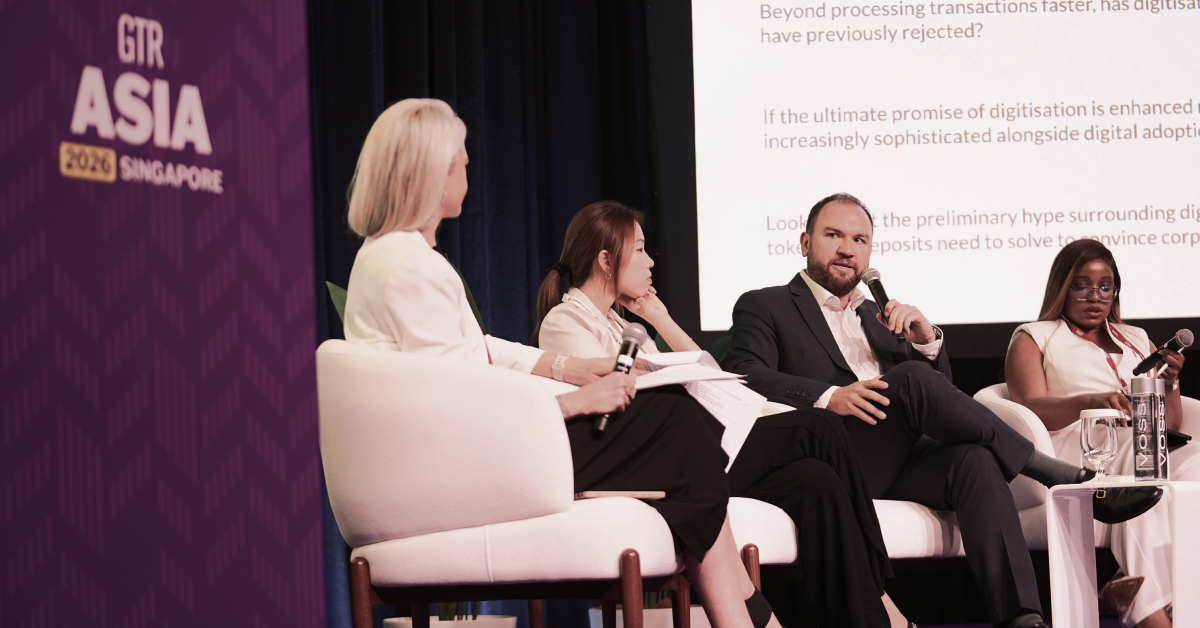
A clear theme emerged across the discussions at GTR Asia 2026: trade finance must look beyond legacy frameworks to secure lasting growth. While digitizing traditional processes has delivered welcome operational efficiency, optimizing legacy systems is no longer enough to weather today’s economic headwinds.
In a global landscape defined by geopolitical shifts, persistent supply chain disruptions, and market volatility, growth will not come from simply polishing existing models. It requires actively redirecting our focus toward opening and derisking new frontiers. Here are my three takeaways from GTR Asia on how we can chart that forward course:
1. Stop Optimizing Yesterday: Find Tomorrow’s Growth
Over the past decade, trade technology has suffered from an obsession with legacy conversion. That is digitizing existing processes without fundamentally expanding commercial opportunity. We have automated paperwork for global corporates on established routes while leaving the underlying mechanics of market expansion completely untouched.
The commercial reality of our sector is straightforward: Nobody wants to pay to optimize a business that’s not growing.
To break free from incremental iteration, the industry must look toward new trade corridors and emerging economic zones. Success must be measured by “first-time ever” trade finance transactions. For example, enabling an exporter to enter an unbanked geography, financing a rising counterparty previously shut out, or unlocking a corridor a bank has never ventured into before. Technology must directly power growth into fresh territories, giving leadership a compelling reason to commit real capital.
2. From Safe Bets to Real Growth through End-to-End Connectivity
When uncertainty rises, standard industry instinct is to retreat into familiar routines, clustering around low-risk, low-margin transactions with top-tier multinationals along established trade routes, and that’s precisely where growth starts to stall. This safe approach creates a stagnant “race to low risk,” compressing margins while growth corridors remain severely starved of capital.
The global ecosystem is not lacking in liquidity; it is overbanked in legacy markets and underfunded in growth corridors. While the market repeatedly debates the Asian Development Bank’s US$2.5 trillion trade finance gap, the better number is the estimated US$11 trillion figure put forth by the International Trade Centre, which highlights the countries that could be trading versus who is currently supported.
To capture sustainable margins, banks must look beyond worn pathways toward emerging markets and mid-sized enterprises. However, the reluctance to finance these new corridors stems from a lack of clear, continuous visibility, as static documents fail to tell the full story. The next chapter demands moving beyond isolated, product-specific paperwork and shifting from document workflows to full lifecycle connectivity. By integrating technology directly with the underlying trade – capturing live demand patterns, real-time vessel tracking, and contextual supply chain data alongside financial documentation – banks and corporates gain the structural transparency required to manage complex risks and step beyond traditional comfort zones.
3. Deploying AI to Measure and Master Unseen Risk
Navigating unfamiliar markets and complex supply chains requires moving beyond manual analysis to intelligent, automated decision-making. Artificial Intelligence provides the missing link for trade finance, turning vast amounts of unstructured trade data and dynamic risk signals into actionable insights.
By leveraging AI, financial institutions can automate counterparty evaluations, detect anomalies instantly, and price risk accurately in previously underserved markets. This predictive engine enables risk committees to act with speed and confidence, transforming how banks structure, monitor, and execute transactions across high-margin global networks.
Building the Infrastructure for Growth
At Mitigram, our mission is clear: to build the digital infrastructure and intelligence layer that enables banks and corporates to break out of legacy routines. By using data to navigate risk and streamline complex executions, we’re empowering our global network to confidently finance the new corridors shaping the future of global trade.